Our traditional carnival characters and their Häs – their distinctive costumes – tell the story of Berghaupten’s Fasent, local legends and mining history.
The Knerbli Witch
Witches have a long tradition in Berghaupten.
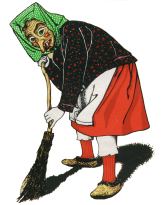 The first recorded mention of men dressed as witches dates from 1938 (source: Offenburger Tageblatt, 23 February 1938). They were causing mischief at the Badischer Hof, then the carnival gathering place in Berghaupten.
The striking green headscarf worn by the Knerbli witches comes from an old Berghaupten legend. A distinctive tradition of our guild is that only men may join the witches’ costume group, while only women may join the Spättle group. The witch’s mask has another unusual feature: its two halves have different expressions, one friendly and one stern – just like life itself.
Looking back through the Knerbli guild’s chronicles reveals names and symbols familiar from carnival literature. Traditional figures and customs such as the Altweibermühle (‘old women’s mill’), the carnival father and mother, torchlight processions and Prince Carnival appear repeatedly in the records from 1938 to 1969.
In the 1950s, Berghaupten’s Council of Eleven organised the carnival celebrations. This carnival association was headed by Prince Carnival, who publicly proclaimed the annual period of carnival freedom. In 1958, the Berghaupten carnival guild had 128 members. Its affairs were led by the fondly remembered Josef Gieringer, whose title was still Narrenvater (‘carnival father’), rather than Oberzunftmeister (‘chief guild master’). Older residents in particular still use that title today.
Why is Berghaupten’s carnival guild called ‘Knerbli’? People from neighbouring villages have long used this nickname for Berghaupten residents. Earlier in the twentieth century, it was also recorded as ‘Knörble’ (source: Offenburger Tagblatt, 6 February 1954). Old stories tell how people from Berghaupten used to cut timber in the neighbouring Zunsweier forest, although the trees did not belong to them. Afraid of being discovered and eager to finish quickly, they cut the trees – mainly oaks – about a metre above the ground. The stump left behind was known as a ‘Knörble’ or ‘Knerbli’.
The Eichel-Spättle
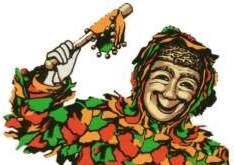 Berghaupten’s forest is also rich in oak trees and their gnarled growths, which are likewise called ‘Knerbli’ or ‘Knörble’ in local dialect. This is how the nickname for Berghaupten’s residents came about – and it was not always meant kindly!
This was probably also why the carnival revellers of the time adopted the name. From it emerged the ‘old lady’ of Berghaupten’s carnival, the Knerbli Witch and the friendly, cheerful Eichel-Spättle characters.
Berghaupten has a ridge called the Bellenberg, now known as the Bellenwald. According to local tradition, its name recalls its dedication to the Celtic goddess Bellina. A Celtic place of sacrifice is said to have stood on this hill.
Local lore traces the lingering fear of the Bellenwald back to those times. Ghosts are said to appear there frequently, along with a legendary old woman – a witch – wearing a green headscarf . These tales gave rise to many superstitions. One says that anyone caught in a thunderstorm in the Bellenwald must make the sign of the cross after every flash of lightning or risk being struck, unless they have a palm frond hanging at home.
The Bergknapp – Miner
 A coal mine operated in Berghaupten from 1755 to 1915. The coal deposit was discovered in 1753 by miners working for the Barons Roeder von Diersburg and von der Leyen of Zunsweier.
At that time, the lords of Berghaupten were the noble von Schleyß family, who lived in the small manor house that is now the town hall.
This important chapter of Berghaupten’s history inspired our probationary costume group, the miners, the Steigercostume group and the Knerblibolderer guild band.
Anyone wishing to join one of the three costume groups – witches, Spättle or Steiger – must first spend at least one year in the Bergknappen probationary group. The overall probationary period lasts at least two years. Under the association’s constitution, only four new applicants can be admitted each year. Other applicants join a waiting list and move forward each year.
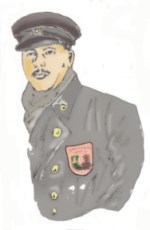
The guild’s Bergknappen outfit is a faithful reproduction, down to the buttons, of the ceremonial uniform worn by Berghaupten’s miners at their 1896 celebration of St Barbara, the patron saint of miners.
The Steiger – Mining Foreman
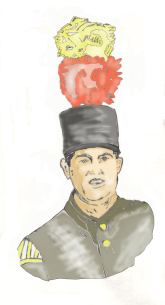 The Steiger, the miners’ foreman, completes this historic tradition in his magnificent uniform. Our Steiger uniform reproduces an original Berghaupten outfit dating from the turn of the twentieth century. The municipality of Berghaupten purchased the original from the local history museum in Zell am Harmersbach, which had acquired it in circumstances that can no longer be traced.
The Burgvogt – Castle Steward
The final traditional Berghaupten character is the Burgvogt, the castle steward who administers and exercises the market and tavern rights of the ‘Free Knerbli Castle’ in Berghaupten.
Each year, at the large village carnival gathering on Carnival Sunday and Shrove Tuesday, he presides over Berghaupten’s carnival community. Nine local associations belong to this community under a friendship agreement concluded in 1994.
The Burgvogt and the ‘Free Knerbli Castle’ draw on several written accounts and traditions from Berghaupten. One concerns Chief Steward Stufer (source: Ein Fluß erzählt Geschichten, Grimmelshausen Verlag), one of the most feared stewards of his time. Legend says that his injustice condemned him to wander as a ghost after his death. His last reported appearance was in the nineteenth century, when carters transporting coal from Berghaupten’s mine to Lahr saw him in the municipal forest.
The castle itself is said to have stood in the area now known as Burgstall. During the Thirty Years’ War, it was the home of Knight Roland of Berghaupten (source: Ein Fluß erzählt Geschichten, Grimmelshausen Verlag), known locally as the ‘Unfortunate Knight’. Swedish soldiers drove his fiancée Edeltraud, daughter of Knight Edelbert of Thiersberg – today’s Diersburg – to her death. Overcome with grief, he handed his possessions to his brother, Knight Rudolf, and became an abbot in a monastery.
To conclude, an old carnival saying captures the spirit of our local and regional Fasent:
‘If someone stands by the roadside and weeps as the revellers burn the carnival tree, they have understood what Fasent means.’.
The Knerblibolderer Band
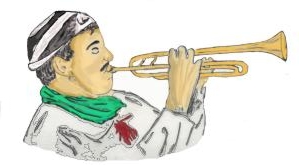 The guild band ‘Knerblibolderer’ traces its origins to the miners’ band of 1896. Its uniform of heavy, sturdy fabric follows the outfit worn at that time.